Downspout installation: where should water drain?
Where should downspout water drain? In Buffalo NY, aim for 4-10 feet from the foundation, downhill, onto splash blocks or into buried lines. Here's how we do it.
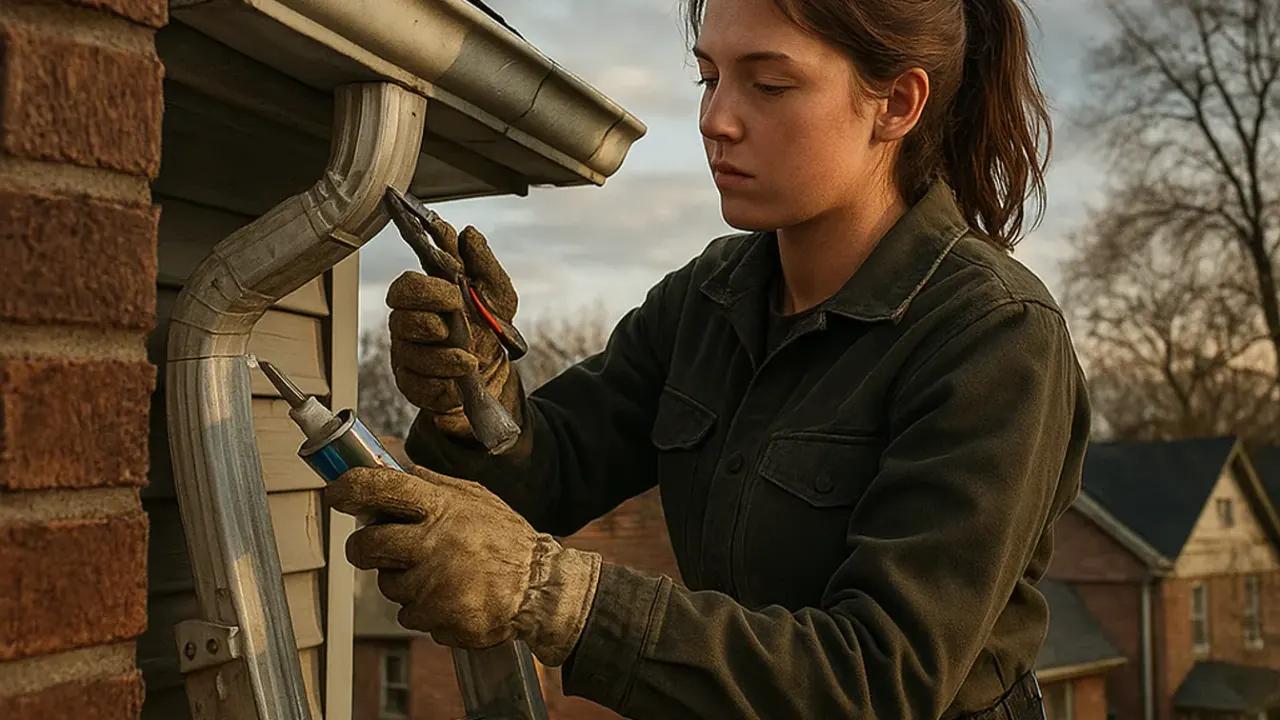
Downspout water should drain 4 to 10 feet away from your foundation, on a slope that carries it downhill and away from the house, never straight down onto the same spot. That is the short answer. The longer answer depends on your lot, your soil, and how Buffalo's freeze-thaw cycles treat your yard between November and April.
Downspout installation where should water drain is one of the first questions we get on almost every estimate call in Buffalo. It is also the question most homeowners get wrong, because the answer is not "as far as the extension reaches" - it is "far enough, downhill enough, and into something that can actually carry it away." Below we walk through the four real drainage options, the distances that work here, and the mistakes that quietly flood basements across the city every spring.
The short answer: 4 to 10 feet, downhill, away from the foundation
The minimum standard for downspout drainage in Buffalo NY is 4 feet of horizontal distance from the foundation wall, with the discharge point sitting lower than the downspout outlet. Six to ten feet is better. If your yard slopes back toward the house, 4 feet is not enough - you need to reach the point where gravity takes over and the water keeps moving on its own.
Downspout installation is the work of positioning the downspout outlet, the extension, and any buried line so that roof water leaves the building envelope and does not return. It is needed whenever a downspout dumps onto a splash block that has sunk, an extension that has cracked, or a yard that grades toward the foundation.
Three numbers to remember:
- 4 feet - absolute minimum distance from the foundation.
- 6 to 10 feet - the range that actually works on most Buffalo lots.
- 1 inch per foot - the slope you want on any buried drain line so it does not sit full of water and freeze solid in January.
Why downspout drain location matters more in Buffalo than almost anywhere
Buffalo gets roughly 40 inches of precipitation a year, and a big share of it arrives as lake-effect snow that melts in a hurry. A single 1,500-square-foot roof sheds about 900 gallons of water during a one-inch rain. During a February thaw, that same roof can release all of it in a few hours.
That water has to go somewhere. If your downspouts dump within 2 feet of the foundation, you are pouring hundreds of gallons into the same clay-heavy soil that surrounds your basement wall. Buffalo's soil holds water. It does not drain it quickly. Add a freeze-thaw cycle that opens cracks in mortar joints, and you have the recipe for the wet basements we get called about every March.
Older neighborhoods feel this hardest. In Gutter Cleaning in Allentown, the housing stock dates to the 1880s and 1890s, and many of those homes have stone foundations with no exterior waterproofing. A downspout that discharges 3 feet from the wall is a slow-motion problem. In Gutter Cleaning in North Buffalo, the 1920s doubles often have original clay tile drain lines that have cracked or root-invaded, so the downspout that used to feed a working line now just feeds the soil.
Where should downspout water drain in Buffalo New York? The four real options
There are four places downspout water can go, and every Buffalo home uses one or a combination of them. The right choice depends on your lot size, your soil, and whether you have a working storm connection.
1. Splash blocks and surface extensions
The cheapest option. A concrete or plastic splash block sits at the downspout outlet and spreads water across the surface so it does not gouge a hole in your lawn. Add a 4- to 6-foot hinged extension and you can push the discharge point out to the 6- to 10-foot range.
The catch: extensions get knocked off by lawnmowers, buried by mulch, and cracked by frost heave. We replace dozens of them every spring. If you go this route, check them after every big storm and re-aim them in November before the ground freezes.
2. Buried drain lines to a pop-up emitter
This is the workhorse solution for Buffalo homes. We trench a 4-inch perforated or solid PVC line from the downspout, slope it at 1 inch per foot, and terminate it at a pop-up emitter 10 to 20 feet from the house. The emitter stays closed until water pressure pushes it open, then closes again to keep rodents and debris out.
Cost in 2026 for a single buried line runs $400 to $900 depending on length, soil, and whether we hit roots or old utilities. It is the option we recommend most often on lots with at least 15 feet of usable yard on the discharge side.
3. Connection to the municipal storm sewer
Some Buffalo homes - especially those built before 1950 - have a direct connection from the downspout into the city storm system. When that line is intact, it is the best possible drainage. When it is cracked, collapsed, or clogged with roots, it becomes a funnel that dumps water right at the foundation.
We scope those lines during a Gutter Inspection Buffalo NY before we trust them. If the line is dead, we cap it and route the downspout to a surface or buried solution instead.
4. Rain barrels and cisterns
A 55-gallon rain barrel captures a useful amount of water for gardens, but it fills in about 10 minutes during a heavy Buffalo storm. Barrels work as a supplement, not a primary drainage solution. If you use one, make sure it has an overflow that routes at least 6 feet from the foundation.
How far should downspouts drain from the house in Buffalo?
Six to ten feet is the target. Four feet is the floor. Anything under 4 feet is a call-back waiting to happen.
Here is how we decide on a specific number for your house:
- Check the grade. If the ground falls away from the foundation at 6 inches over 10 feet, a 6-foot discharge works. If it is flat or slopes back, you need a buried line to reach a real low point.
- Check the soil. Buffalo's clay-heavy soil percolates slowly. Sandy or amended soil drains faster and tolerates a shorter run.
- Check the basement. If you have ever had water in the basement, add 4 feet to whatever you were planning. You are not just moving water - you are moving it past the zone where hydrostatic pressure builds against the wall.
- Check the neighbors. Do not discharge onto a property line or into a neighbor's yard. Route the line to a point that stays on your lot.
One more Buffalo-specific note: the discharge point has to stay below the frost line if it is buried, or the line has to be sloped steeply enough that it drains completely before freezing. A buried line that holds water through a January cold snap will crack. We slope every line we install so it empties itself.
What is the best downspout drainage in Buffalo New York?
For most Buffalo homes, a buried 4-inch PVC line running 10 to 20 feet to a pop-up emitter is the best downspout drainage you can install. It is out of sight, it does not get knocked around by lawn equipment, and it moves water far enough that the foundation never sees it.
Splash blocks and extensions are fine as a temporary fix or on a tight lot. They are not a permanent answer in a city that gets 40 inches of precipitation and a hard freeze every winter.
If you are already dealing with sagging gutters or a downspout that pulls loose every season, the drainage question is secondary to the hardware question. We handle both. Our Downspout Installation Buffalo NY service covers new downspout runs, re-routing, and tying the outlet into a proper drain. If the gutters themselves are failing, Gutter Replacement Buffalo NY is the conversation to have before you spend money on drainage for a system that cannot move water in the first place.
Common mistakes we see on downspout installation jobs
Most downspout drainage problems come down to five recurring errors. We see all of them every week.
- Dumping onto a splash block that has sunk into the ground. After two winters, that block is a bowl. Water pools right at the foundation.
- Running a buried line uphill. If the emitter is higher than the downspout outlet, the line never drains. It freezes, splits, and stops working.
- Connecting to a dead storm line. The pipe looks fine from the outside. Inside, it is collapsed or full of roots. Water backs up and exits at the lowest point - usually your basement.
- Discharging onto a driveway or sidewalk. The water runs along the pavement and straight back to the foundation, or it freezes into a sheet of ice that stays until March.
- Using a 2-inch extension on a 3x4 downspout. Undersized extensions overflow in a heavy rain. Match the extension to the downspout capacity.
One more: never let a downspout discharge into a window well. We see it more often than you would think, and it is the fastest way to get water into a basement.
When to call a professional for downspout installation
Call us when the water is landing within 4 feet of the foundation and you cannot fix it with a longer extension. Call us when you have a buried line that no longer drains. Call us when you are not sure whether the storm connection under your lawn is alive or dead.
We find the low point, check the grade, scope any existing line, and install a drainage path that actually works through a Buffalo winter. If your gutters need work too, we handle that on the same visit. You can see the full range of what we do at Gutter Cleaning Buffalo NY.
If you are in the older parts of the city - say Gutter Cleaning in South Buffalo, where 1920s bungalows sit on tight lots with mature trees - we will often recommend a shorter buried run to a shared low point rather than a long surface extension that gets buried in leaves every fall.
Frequently Asked Questions
Where should downspout water drain in Buffalo NY?
At least 4 feet from the foundation, ideally 6 to 10 feet, on ground that slopes away from the house. The best option for most Buffalo homes is a buried 4-inch PVC line running 10 to 20 feet to a pop-up emitter. Never discharge onto a flat splash block that sits against the wall.
How far should downspouts drain from the house in Buffalo?
Six to ten feet is the working range. Four feet is the absolute minimum. If your yard slopes back toward the foundation or you have had basement water before, push it to 10 feet or more with a buried line. Buffalo's clay soil does not absorb water quickly, so distance matters more here than in sandier regions.
What is the best downspout drainage in Buffalo New York?
A buried PVC line to a pop-up emitter, sloped at 1 inch per foot so it empties completely before freezing. Expect $400 to $900 per line in 2026 depending on length and soil conditions. Splash blocks and extensions are a temporary fix, not a permanent solution in this climate.
Who installs downspouts in Buffalo?
Witz Gutter Cleaning installs and re-routes downspouts across Buffalo, including Allentown, North Buffalo, South Buffalo, and the surrounding neighborhoods. We handle new runs, replacements, buried drain lines, and connections to existing storm lines. Call 716-215-7938 to schedule an estimate.
Get help with Gutter Cleaning in Buffalo
If your downspouts are dumping water next to the foundation, we can fix it before the ground freezes. We will check the grade, scope any existing drain line, and install a discharge point that moves roof water where it belongs.
Call Witz Gutter Cleaning at 716-215-7938 to book a downspout and drainage estimate in Buffalo.